Padel vs Tennis: differences, transition, equipment (2026 guide)
Padel or tennis in 2026: technical differences, rules, equipment, learning curve. How to switch from tennis to padel without parasitic reflexes. Complete guide.
Padel vs Tennis: differences, transition, equipment (2026 guide)
Padel and tennis look similar at first glance: two racket sports pitting two or four players on a delimited court. But beneath the surface, the two disciplines obey opposite logics. Tennis values power and baseline coverage; padel rewards precision, reading wall bounces, and doubles coordination.
For the 60% of French padel players who come from tennis (per FFT surveys), understanding these differences avoids months of parasitic reflexes. For beginners hesitating between the two, this guide gives the technical basics, distinctive rules, comparative cost, and learning curve of each sport.
TL;DR
- Court: 20×10m closed by glass and fences (padel) vs 23.77×8.23m singles, open (tennis)
- Serve: underhand below the waist after a bounce (padel) vs overhead without bounce (tennis)
- Format: doubles only (padel) vs singles or doubles (tennis)
- Racket: solid, perforated, no strings (padel) vs strung oval long-handle (tennis)
- Learning: 20 minutes to sustain a rally in padel, 3-5 sessions in tennis
- Practical cost: padel generally cheaper in France (€8-14/player 1h30 vs €25-40 tennis court)
The court: open vs closed, that's everything
The fundamental difference between padel and tennis is visible before you even play.
Tennis court: 23.77m long by 8.23m (singles) or 10.97m (doubles). Open space. As soon as the ball goes out of bounds, the point is over. The court size rewards mobility, endurance, and the ability to exploit short or long angles.
Padel court: 20m × 10m, fully enclosed by side and back glass walls (typically 3 metres high on the sides, 4 metres at the back), complemented by metallic fences at the corners. The ball never goes out, it bounces off the walls and stays in play. This particularity changes everything: a powerful shot pushing the opponent to the back can come back at you via the glass bounce, transforming your attack into potential defence.
Strategic consequence: padel rewards placement and precision, not raw power. A tennis-trained beginner who hits hard in padel hands easy points to opponents via wall bounces. The "hit harder" reflex must be unlearned.
The serve: the most counter-intuitive transition
This is probably the point that surprises ex-tennis players the most.
Tennis serve: overhead motion (ball above the head), ball thrown in the air and struck without bounce, can reach 200+ km/h at pro level. The serve is a major offensive weapon: a good serve directly produces points (aces, service winners).
Padel serve: underhand motion, ball mandatorily struck after a ground bounce, below the waist. Both feet must be behind the baseline, between the central line and the side glass. Typical speed 40-60 km/h. The padel serve is not an offensive weapon. It's a neutral starting shot that initiates the rally.
For an ex-tennis player, unlearning the overhead reflex takes 5-10 sessions. The instinctive tendency is to step back to prepare a tennis serve; instead you should stay close to the line and execute the underhand motion as soon as the ball bounces.
Game format: doubles only vs choice
Padel: exclusively doubles. 2 vs 2, period. This rule structures the entire sport: communication with your partner, court positioning as a pair, sharing volleys at the net. Padel is by nature a collective and social sport.
Tennis: singles or doubles, with singles being the historical and most-played format outside federation competition. Recreational tennis often oscillates between the two depending on player count and weather.
Social consequence: padel integrates a community dimension by default (you always need 3 partners, or none). Finding a partner at matching level is one of the recurring stakes. See how the booking platforms differ on the matchmaking side in our Playtomic vs Anybuddy comparison.
Try Padel Snipe for free
Set up your first alert in 2 minutes. No credit card required.
Get started for free →Racket: solid vs strung, two worlds
Visually, this is the most distinctive element of the two sports.
Tennis racket: oval, strung (typically 16 vertical × 19 horizontal strings), long handle (~70 cm), weight 280-310g for adults. The strung face offers a large hitting surface and allows spin (topspin, slice).
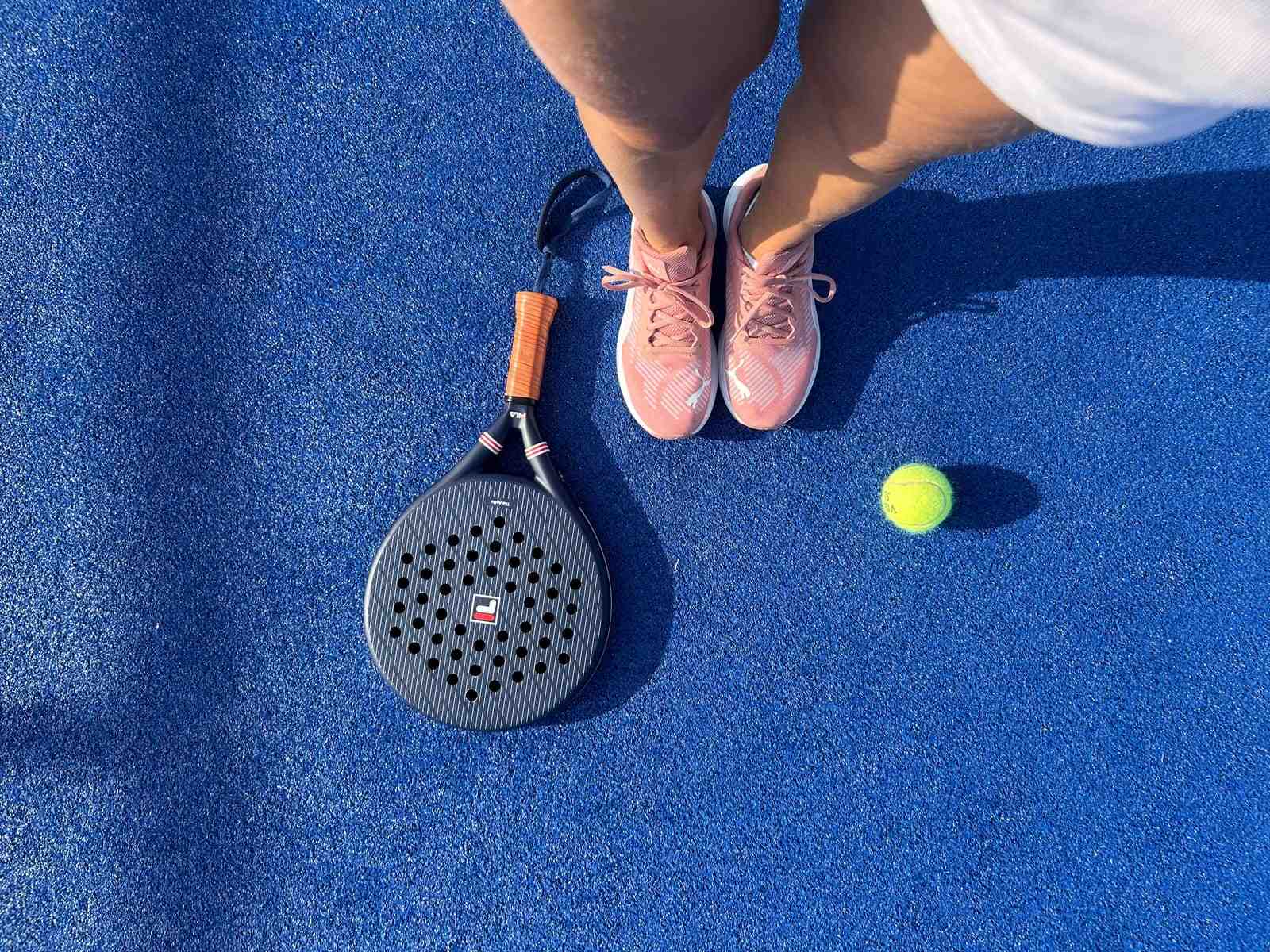
Padel racket: solid (no strings), face perforated with holes (typically 50-100 holes), short handle (~38 cm total), weight 355-375g for beginners. The hard face transmits impact differently and limits spin: padel is played flatter, with less topspin than tennis.
A tennis racket is unusable on a padel court (and vice versa). For an ex-tennis player starting padel, the recommendation: round fibreglass racket 355-375g, budget €40-80, reliable brands (Head, Bullpadel, Adidas, Wilson). Avoid diamond rackets (high-end triangular shape) until you have 6 months of practice: the narrow sweet spot penalises imprecise strikes.
Learning curve: padel faster to start
This is the point that pushes many adults to choose padel as their first racket sport.
Padel: most beginners can sustain a rally (4-5 consecutive strokes) within their first 20 minutes on the court. Three reasons:
- Smaller court, easy to cover with a partner
- Underhand serve without complex motion
- Padel ball less pressurised than tennis ball (lower bounce, slower speed)
Tennis: reaching the same stage (regular 4-5 stroke rallies) typically takes 3-5 sessions for an adult without racket background. The tennis serve alone requires 2-3 sessions to function correctly.
Marketing consequence for padel: it's the racket sport offering the gentlest learning ramp for an adult. Operators (clubs, FFT) made this a key argument to democratise the sport, and the strategy clearly worked: padel went from near-zero in 2018 to over a million practitioners in France in 2026.
Tactics: individual power vs collective precision
Tennis: the sport rewards individual intensity and power. A topspin forehand at 130 km/h into the corner, a short slice backhand, a well-executed serve-and-volley: tennis is a sport of explosive sequences where each shot can be a winner.
Padel: the sport rewards precision and collective placement. A well-measured lob pushing opponents to the back, a slice that dies after the bounce, a flat shot at the feet: padel is a sport of patient construction where points are won by wearing down opponents more than by occasional winners.
This difference explains why players who plateau in tennis (lacking power, speed, endurance) often progress faster in padel: precision and game reading matter more than physical attributes.
Comparison table
| Criterion | Padel | Tennis |
|---|---|---|
| Court size | 20 × 10m enclosed | 23.77 × 8.23m (singles) open |
| Glass and fences | Yes, integrated into play | None |
| Format | Doubles only | Singles or doubles |
| Serve | Underhand, after bounce, below the waist | Overhead, no bounce, above the head |
| Serve speed | 40-60 km/h | 100-200+ km/h |
| Racket | Solid, perforated, short handle, 355-375g | Strung oval, long handle, 280-310g |
| Ball type | Reduced pressure, low bounce | Pressurised, standard bounce |
| Beginner learning | 20 minutes to sustain a rally | 3-5 sessions |
| Style | Precision, placement, doubles | Power, mobility, individual |
| Practical cost France | €8-14/player 1h30 | €25-40 tennis court 1h |
Comparative cost: padel generally cheaper in France
Padel France 2026: €36-56 per court 1h30 (€8-14 per player at 4). Marseille and Toulouse on the lower end (€9-13), Paris and Côte d'Azur on the higher end (€12-20).
Tennis France 2026: indoor court €25-40/h, outdoor court €15-25/h. Played in singles, more expensive per player. Played in doubles, per-player cost is comparable to padel but the tennis experience suits doubles less.
Equipment:
- Padel beginner racket: €40-80
- Tennis beginner racket: €80-200
- Padel-specific shoes: €40-100 (different from tennis shoes due to footwork on synthetic surfaces)
- Padel balls (3): €5-8 vs tennis balls (3): €5-10
Over 12 months of regular practice (1 session/week), padel typically costs €800-1,200/year all-in (equipment + courts), vs €1,000-1,800/year for tennis under the same conditions.
How to switch from tennis to padel without parasitic reflexes
If you're a tennis player discovering padel, here are the 5 reflexes to unlearn first:
1. The overhead serve: forget the tennis motion. Stay close to the line, let the ball bounce, hit underhand below the waist. Practice 50 consecutive serves before your first match. It's the most cost-effective time investment.
2. Power as a weapon: a powerful shot in padel is often a gift to the opponent (the ball comes back via the glass). Hit at 70% of your usual power and focus on placement: angle, depth, height over the net.
3. Swing amplitude: shorten your swing. Padel rewards short clean strikes, not tennis amplitudes. Lower preparation, shorter follow-through.
4. Wall bounce management: this is the purely padel skill no tennis background gives you. When the opponent's ball passes you at the back, don't consider it lost: it'll bounce off the back wall and return. Turn, follow the ball with your eyes, hit after the bounce. This reflex takes 10-15 sessions to integrate naturally.
5. Mandatory doubles: think collectively. Communicate with your partner about who takes central balls, who steps to the net, who covers the lob. Silence in padel costs points.
Allow 5-10 sessions before these adjustments become automatic. That's the period during which your tennis reflexes actively hurt you, after which your technical background starts becoming an advantage.
Should you choose, or play both?
At recreational level, alternating padel and tennis is beneficial: tennis trains power, endurance, mobility; padel trains precision, game reading, doubles coordination. Many regular players do both in parallel, especially in France where mixed tennis-padel clubs are common.
At competitive level, choosing becomes necessary beyond a certain threshold. Techniques (serve, smash, grip) diverge enough that optimising both dilutes progress. The FFT structures padel rankings separately from tennis rankings since 2014.
Practically: if you want to play both, configure your clubs on the right platforms. Anybuddy lets you book tennis and padel in the same app, simplifying multi-sport logistics. See our Playtomic vs Anybuddy comparison for details. On Playtomic clubs, automating booking on the most contested slots is handled via Padel Snipe, useful where padel demand saturates evenings and weekends.
Verdict: padel or tennis based on your profile
Choose padel if:
- You're discovering racket sports as an adult → gentler learning ramp
- You value the collective and social dimension → mandatory doubles
- You're looking for the most accessible racket sport in cost and equipment
- You live in an urban area with few available tennis courts → padel infrastructure denser and growing
Choose tennis if:
- You already have a solid tennis background to build on
- You value individual play and physical performance
- You target high-level competition in a mature sport
- You want to play singles without depending on a partner
Do both if:
- You're a regular recreational player without competitive aim
- You want to balance power/precision in your sports practice
- You belong to a mixed tennis-padel club offering both
In the end, padel exploded in France because it drastically lowers the barrier to entry to racket sports for adults, while remaining technical enough to offer decades of progression. Tennis remains the reference for tactical depth and individual power. Both sports will coexist in the French landscape for a long time, and many players will do both depending on mood, age and engagement level.
External sources: LTA: padel vs tennis, Babolat: padel or tennis, FFT padel.
Ready to automate your bookings?
Set up your first alert in 2 minutes. Free to start.
Get started for free →